How to Get Up to 60% Back on Solar in Andalucía
Most homeowners recover around 40% through tax deductions, but only if the system is designed and documented correctly.
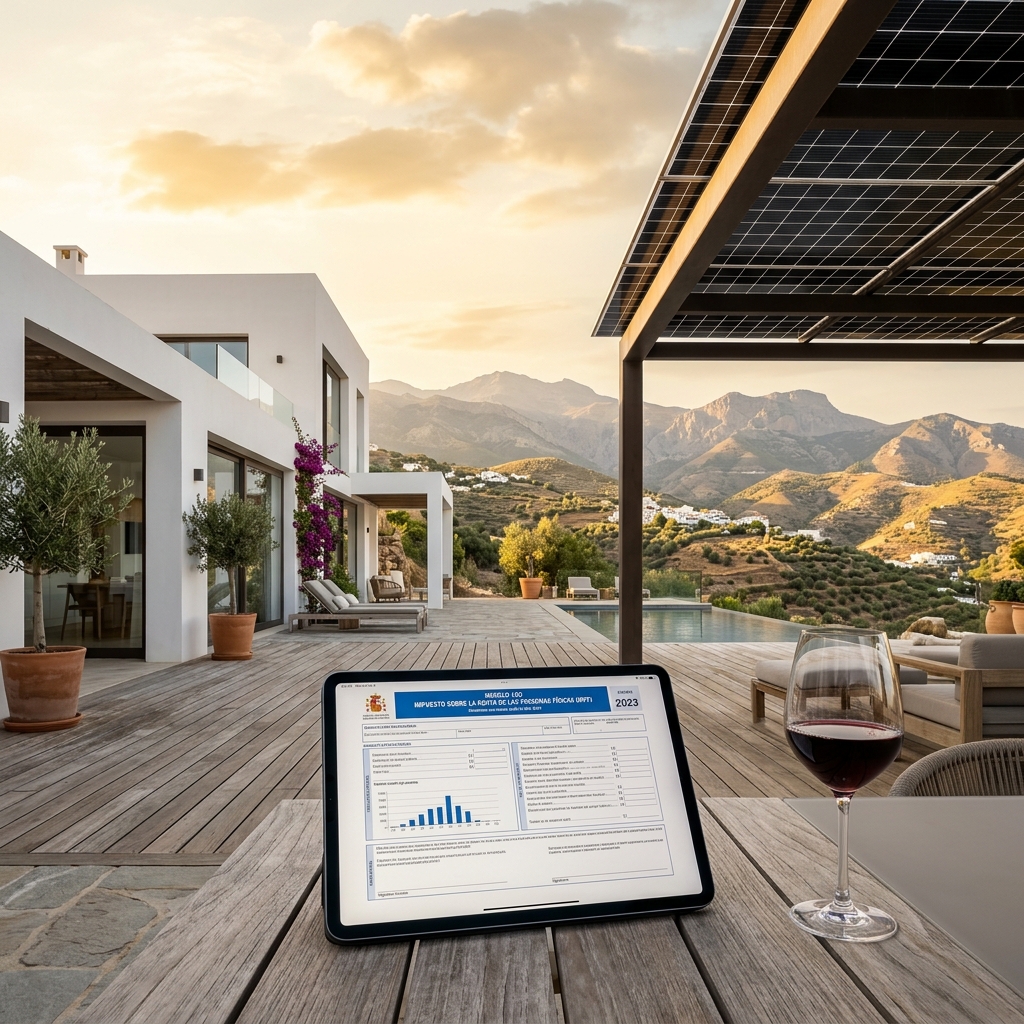
This is not a grant. It is a tax deduction claimed through your annual Spanish income tax return — what your gestor calls the declaración de la renta. The amount you recover depends on how much your home's energy efficiency improves, as measured by official certificates. Not by the number of panels on your roof. Not by the size of your inverter. By the certificate.
Get the paperwork wrong and you lose thousands. Get it right and a €10,000 solar system effectively costs you €6,000.
How much can you get back on solar in Spain?
of total installation cost for most properly designed systems
depending on energy efficiency improvement achieved
- Before and after energy certificate (Certificado de Eficiencia Energética)
- Improvement must be measurable and certified
- Claimed via annual IRPF tax return (declaración de la renta)
- Payment by bank transfer — not cash
- System installed before 31 December 2026 (current confirmed extension)
How the Spanish solar tax deduction actually works
Here is something a lot of homeowners — and quite a few installers — get wrong. The Spanish government does not care how many solar panels you put on your roof. It does not subsidise panels. What it rewards is measurable improvement in your home's energy efficiency. Solar happens to be one of the best ways to achieve that improvement, but the deduction is tied to the result, not the hardware.
This is why the certificado de eficiencia energética is everything. Two identical villas in Cómpeta could install the same 6kW system and qualify for completely different deduction levels — because one started with an F rating and jumped to a C, while the other was already a D and barely moved. The certificate, issued by an accredited technician and registered with the Junta de Andalucía, is the legal proof that the improvement happened.
Your installer alone is not enough. They can fit the panels and connect the system beautifully, but the energy certificate is a separate process handled by a qualified energy assessor. Both steps need to happen in the right order, and both need to be documented properly. If either step is missed or done out of sequence, the tax office will reject the claim.
We have seen homeowners lose €4,000 or more because an installer told them “don't worry about the paperwork, just get it done afterwards.” That advice is wrong and it is expensive.
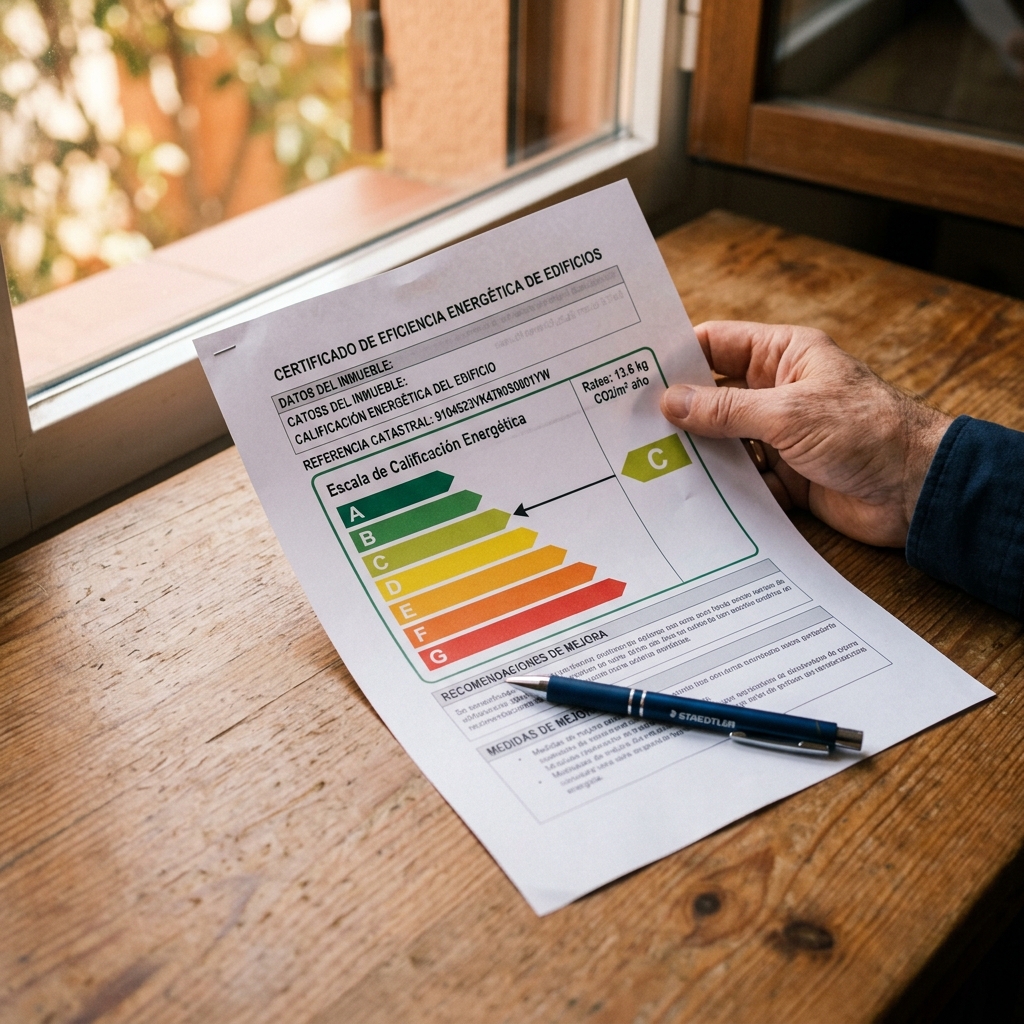
The energy certificate — not the solar panels — is what determines your deduction level. Most older homes in the Axarquía start at E, F, or G. That is actually good news for the deduction.
The three IRPF deduction tiers explained
The deduction you qualify for depends entirely on the improvement shown by your energy certificates. Here is what each level means in practice — and which one you should be aiming for.
Basic improvement
7% reduction in heating/cooling demand
€5,000 per year
Where undersized systems end up. A 2-panel install on a large villa will clear 7% but go no further. If you land here, the system was probably too small for your home.
The level to design for
30% reduction in non-renewable energy OR achieve EPC A or B
€7,500 per year
A properly sized system on a typical Axarquía villa — covering 60–80% of daytime consumption — will usually clear this threshold. Especially when the home starts at D, E, or F (which most older properties do).
Full building renovation
30% reduction for entire building, or building-level EPC A/B
€5,000 per year (longer period)
This tier is for apartment blocks and comunidades de propietarios. Rarely applicable to individual villas. Be cautious of any installer who promises 60% on a single-home project.
What you actually get back — no spin
This €4,000 reduces the income tax you owe on your next declaración de la renta. If your tax bill for the year is €6,000, you pay €2,000 instead. Your effective system cost drops to €6,000. Add the annual electricity savings on top of that, and most systems pay for themselves within 5–7 years.
If your tax bill is less than €4,000, you use what you can and carry the remainder forward to the next tax year — up to four additional years. Your gestor handles this as part of the standard filing process.
Important: this is not cashback
Nobody sends you a cheque. The Spanish tax office (Agencia Tributaria) does not transfer money into your account for installing solar panels. The deduction reduces your tax liability — the amount of IRPF you owe when you file your annual return. If you typically receive a small refund, the solar deduction increases that refund. If you usually pay, it reduces or eliminates the payment.
This means you need sufficient taxable income in Spain to benefit fully. For retirees in the Axarquía living on a UK or Scandinavian pension that is taxed in Spain, this usually works fine. For part-year residents with very low declared income, the carry-forward provision helps but the benefit takes longer to realise. Talk to your gestor before committing — they can tell you quickly whether the numbers work for your situation.
Step by step: how to claim the solar IRPF deduction
The sequence matters. Do these steps out of order and you will not qualify. This is the exact process we follow with every installation.
Get your BEFORE energy certificateCritical — must happen before installation begins
An accredited energy assessor visits your home and produces a Certificado de Eficiencia Energética (CEE). This establishes your baseline energy rating — typically E, F, or G for older Andalucían properties. The certificate must be registered with the Junta de Andalucía before any installation work begins. This is not a formality — it is the foundation of the entire deduction claim.
If Step 1 is missed, the entire deduction is lost. There is no retroactive fix. No exceptions, no appeals. We have seen this cost homeowners €4,000 or more.
Install the solar system — sized correctly
The system is designed and installed to maximise the energy efficiency improvement — not just to fill your roof or hit a budget number. Correct sizing is what determines whether you reach the 30% improvement threshold (and the 40% deduction) or fall short at 20%. A 4kW system on a home that needs 6kW does not just underperform — it costs you €2,000 in lost tax benefit.
Get your AFTER energy certificate
Once the system is operational, the assessor issues a new CEE reflecting the improved energy performance. This is also registered with the Junta de Andalucía. The gap between the two certificates — your before rating dropping from, say, F to B — is what legally qualifies you for the deduction tier.
Keep your payment documentation clean
All payments must be by bank transfer — cash will not be accepted. You need a proper invoice from the installer showing IVA breakdown, and matching bank transfer records. Keep everything. Your gestor will need these documents when filing the return, and the Agencia Tributaria may request them if they query the deduction.
Claim on your annual tax return
When you file your IRPF (declaración de la renta), include the solar investment with all supporting documentation: both energy certificates, invoices, and bank transfer records. Most homeowners in the Axarquía use a local gestor fiscal who handles this as standard. If you file yourself, you can do it through the Agencia Tributaria online portal — but get professional help the first time.
How long does the whole process take?
From initial assessment to receiving the tax benefit, expect 6 to 18 months total. The installation itself is fast — most residential systems go up in under a week. The certification process takes a few weeks either side. The financial benefit arrives when you file your next annual tax return, which for work completed in 2026 means the return filed in spring/summer 2027. It is not instant, but it is reliable.
Current solar incentives in Andalucía
IRPF deductions — the primary route
The IRPF deductions for energy efficiency improvements are active until 31 December 2026 under the current confirmed extension of the legislative framework (Real Decreto-ley 18/2022 and subsequent extensions). Systems must be installed and certified before the end of 2026 to qualify. This deadline has been extended several times — we update this page whenever the framework changes.
Regional grants — Junta de Andalucía
The Junta de Andalucía, through the Agencia Andaluza de la Energía, has historically offered direct grant programmes covering 15% to 45% of installation costs, funded through EU Next Generation money.
In practice, these grants have been heavily oversubscribed. Application windows close within days. Processing takes 12–18 months. Many applicants receive nothing. If a new round opens, it is worth applying — but do not delay your installation waiting for one. The IRPF deduction is the reliable path, and it does not require an application or waiting list.
IBI reduction (municipal)
Some municipalities offer reductions on the annual property tax (IBI) for homes with solar. This varies by ayuntamiento. Where available, it typically provides a 25–50% IBI reduction for 3–5 years — a small but welcome bonus on top of the IRPF deduction.
Five mistakes that cost homeowners thousands
We are not guessing here. These are things we see repeatedly in the Axarquía — from homeowners who installed with other companies, or who tried to manage the process themselves.
No before certificate
The most expensive mistake, and the most common. The installer fits the system, everything works perfectly, and the homeowner contacts their gestor to claim the deduction — only to discover they needed an energy certificate from before the installation. There is no fix for this. The certificate must predate the installation. We have seen this happen three times in the last year alone, always with different installers. €4,000 lost each time.
System designed on budget, not on your actual consumption
A homeowner in Sayalonga installed a 3kW system because it was cheaper. Their consumption justified 5.5kW. The smaller system improved their energy rating enough for the 20% tier but not the 40% tier. On a €6,500 spend, they got €1,300 back instead of €2,600. The extra €2,000 investment in a properly sized system would have paid for itself immediately through the higher deduction. Use the sizing tool — it takes two minutes and avoids this entirely.
Installer does the electrics but ignores the paperwork
Many installers — good ones, technically — focus on the electrical work and leave the certification process to the homeowner. “You sort out the certificate, we sort out the panels.” That sounds reasonable until nobody coordinates the sequence. The before certificate gets forgotten, the after certificate gets delayed, and the tax deadline passes. A responsible installer manages this timeline alongside the installation.
Expecting a payment from the government
This comes up in almost every first conversation. “When does the government send the money?” They don't. The deduction reduces your income tax bill — it is not a separate payment. If you do not file a Spanish tax return, or if your tax liability is zero, the immediate cash benefit is nil (though carry-forward helps). Worth clarifying before you sign anything.
Not enough taxable income to use the deduction
Particularly relevant for retired expats in the Axarquía. If your annual IRPF bill is only €1,500, a €4,000 deduction saves you €1,500 in year one — the rest carries forward. That is fine, but it takes three or four years to recoup the full amount. For some people that is perfectly acceptable. For others, it changes the financial equation. Know your numbers before you commit.
Tax implications once your system is running
Good news first: the electricity you generate and use yourself is not taxable. Self-consumed solar energy is a saving, not income, and it does not need to appear on your tax return.
If you export surplus energy back to the grid, the tax treatment depends on your setup. Most homeowners here use a batería virtual (virtual battery) arrangement, where surplus generation creates credits that offset future electricity bills rather than generating direct income. In practice, this means your electricity bill goes down but you do not receive a payment — so there is usually nothing to declare.
If you do receive direct compensation for exported energy, that may be taxable. Consult your gestor about your specific contract with the distributor. For most residential systems in the Axarquía, this is straightforward and your gestor will have handled it before.
Not sure whether your property would reach the 30% threshold? A quick assessment based on your electricity bill usually gives a very accurate answer — before you commit to anything.
Common questions about solar tax deductions in Spain
The most important question is not the price. It is whether the system will qualify for the 40% deduction.
We calculate that properly — based on your actual usage, your property, and your current energy rating. No obligation, no pressure, no sales pitch. Just the numbers you need to make the right decision.
Get a Free Solar AssessmentThis guide was last updated in April 2026. IRPF deductions for energy efficiency improvements are confirmed active until 31 December 2026 (current confirmed extension). Competa Solar is based in the Axarquía region of Andalucía and specialises in residential solar installations.
Government incentives are subject to extension and revision. This page reflects the current framework as of 2026. We update it whenever the legislation changes.